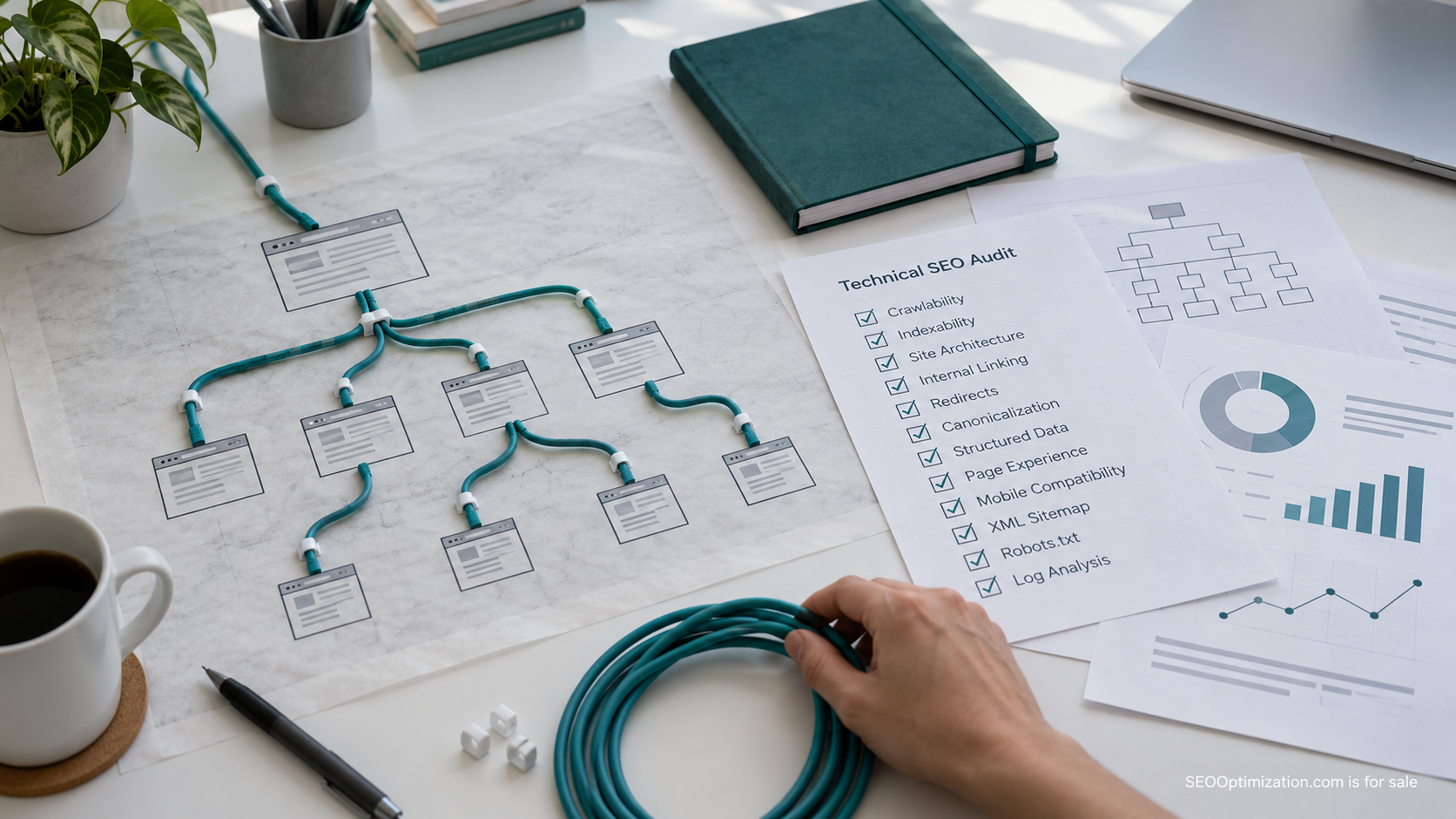
Technical SEO checklists grow until nobody trusts them. This guide is a short ordered list of crawl and index work that actually moves risk off the table, plus notes on what to skip when tools disagree. It is not a guarantee of rankings. Use it to audit one template, not to decorate a slide with fake urgency.
What this checklist is for
Operators need a shared order of operations when a site ships new templates, migrates, or accumulates crawl debt. The goal is risk reduction: can important URLs be discovered, rendered enough to be understood, and kept in the index without soft-404 theater? Rankings and revenue come later and depend on content and demand. Technical work clears blockers; it does not invent demand.
Read this as a working order for one priority template family (category page, product page, article, location page). Expanding to the whole site before one family is healthy usually creates noise.
Ordered checklist
1. Confirm the URL set that matters. List the templates and example URLs stakeholders agree are revenue or mission critical. If that list does not exist, stop and write it. Tools that crawl everything will distract you with low-value paths.
2. Check discovery. Can crawlers reach those URLs through internal links and, where appropriate, sitemaps? Look for orphaned templates, parameters that explode, and navigation that hides key paths behind scripts without server-rendered links. Prefer evidence from your logs or a controlled crawl over a single tool’s “health score.”
3. Check index eligibility. Review robots rules, noindex, canonicals, and login walls on the priority set. Canonical chains and conflicting signals are common. Fix conflicts on the template, not with one-off patches on random URLs.
4. Check status and soft errors. Important URLs should return the status you intend. Soft 404s, thin doorway patterns, and accidental redirects deserve attention before fancy structured data work.
5. Check primary content availability. If critical copy or product data only appears after delayed client rendering, validate with a method your team trusts. The point is whether the main content is available to crawlers and users in a stable way, not whether a lab screenshot looks dramatic.
6. Check duplication patterns. Facets, sorts, tracking parameters, and HTTP/HTTPS or www variants should not multiply indexable copies of the same intent. Prefer template-level rules.
7. Check page experience basics that block use. Broken mobile layouts, unusable forms, and interstitial patterns that hide content matter because they harm users and can affect how search systems treat pages. Treat page experience guidance as practical UX risk management, not a magic ranking lever.
8. Check structured data only when it explains something real. Add types you can keep accurate. Fake Product or Review markup is a liability. If you cannot maintain it, skip it.
9. Re-measure the priority set. Confirm discovery, eligibility, and status after fixes. Document residual risk. Only then expand scope.
When tools disagree
They will. One crawler reports a blocking script; another does not. Search Console samples differ from your full crawl. Treat disagreement as a prompt to inspect the URL yourself with a consistent method. Ask: is the issue on the template or on one URL? Is it reproducible? Does it affect the primary content or a secondary widget?
Skip endless debates about which tool’s proprietary score is “right.” Scores are summaries. Your checklist items are decisions. If two tools conflict on a low-priority URL, park it. If they conflict on a money template, escalate with screenshots, response headers, and a proposed template fix.
What to skip early
Skip vanity cleanups that do not change discovery or eligibility for the priority set. Skip mass URL parameter projects before you know which parameters matter. Skip decorative schema. Skip rewriting every title tag while canonicals conflict. Skip “AI-generated technical SEO reports” that dump hundreds of low-severity notes without owners.
Also skip ranking guarantees dressed up as technical milestones. Closing crawl errors is good work. It is not a promise of position.
Worked example: one article template
A publisher ships a new article template. The priority set is the template’s live articles from the last ninety days. Discovery check finds related-article modules that omit links in the server-rendered HTML. Index eligibility finds a staging noindex leaked on a subset via a CMS flag. Status checks are clean. Primary content is present in initial HTML. Duplication is limited to a printable view that should be noindex. Page experience shows a cookie banner that delayed interaction on mobile; the team fixes focus order and contrast. Schema is skipped until authors can maintain Article fields. After fixes, the team re-crawls the sample and records residual risk: older articles still use the previous template and will migrate next sprint.
That story is illustrative. Your CMS and stack will differ. The order stays useful: priority URLs, discovery, eligibility, status, content availability, duplication, UX blockers, then optional structured data.
Handoff and ownership
Every checklist item needs an owner. SEO can triage; engineering usually ships template fixes; content owns thin page decisions; analytics confirms measurement still works after URL changes. Write owners into the ticket, not into a slide that nobody updates.
For public documentation habits, keep a short internal glossary aligned with Google Search docs so debates use shared terms. Shared vocabulary reduces tool-war theater.
Next step
Audit one template against this list this week. Record what you fixed, what you skipped, and why tools disagreed. If you are evaluating SEOOptimization.com as a domain for an agency, SaaS tool, or program hub that teaches this kind of work, inquire with your use. The domain sale is separate from this checklist; the checklist stands alone as an operator aid.
Migration notes
Migrations amplify technical risk. Keep the same ordered checklist, but add redirect mapping for priority URLs, a freeze window for template experiments, and a rollback plan. Validate a sample of old-to-new paths before and after launch. Do not celebrate a migration because a tool score improved on day one. Celebrate when priority URLs remain discoverable and eligible a week later.
Document decisions in a shared log: what changed, who approved, what residual risk remains. Future teammates will need that log more than a slide celebrating “technical SEO complete.”
How this relates to buying a category domain
Teams that take checklists seriously often want a public address that matches the work. That is a separate commercial decision from the crawl fixes above. If SEOOptimization.com fits an agency, SaaS, or program hub you are planning, use the inquire form. If you only needed the checklist, stop here and audit one template.