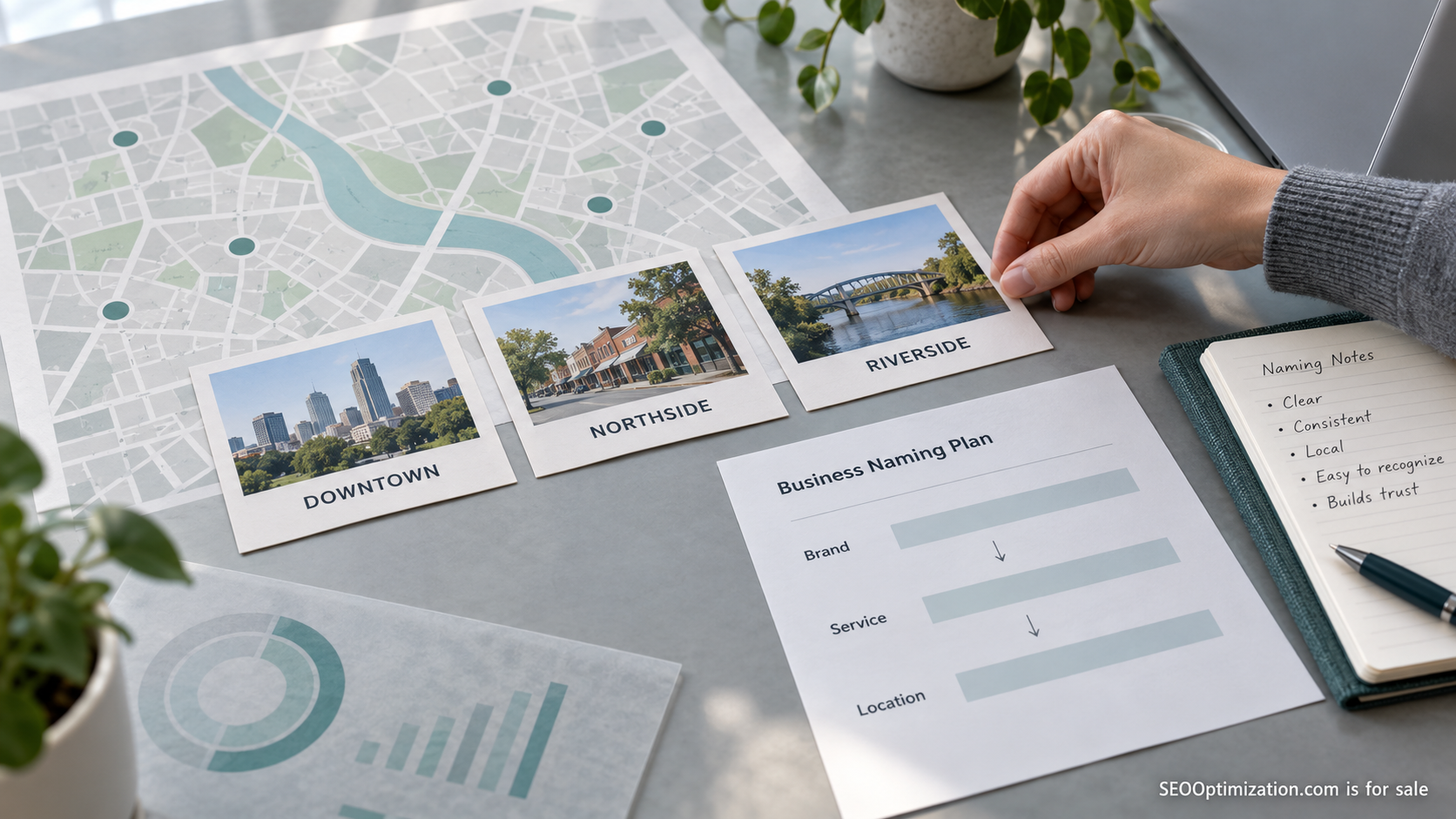
Category-heavy names create local SEO confusion when NAP and brand strings drift across locations. This guide covers naming patterns for multi-location versus single-market offers so operators can keep listings and landing pages clear. Patterns are illustrative and vary by market. They are not legal advice and not a claim about SEOOptimization.com as a live local business.
Reader job
You need to avoid NAP and brand confusion when the product or service name leans on a category phrase. The takeaway is a small set of naming patterns and a mapping exercise for your locations.
Why category names get messy locally
Exact category domains and trade names travel well in national speech and poorly when every city page invents a slightly different business name. Listings, citations, and location pages then disagree. Users see one string in Maps and another on the site. Search systems and humans both struggle.
The fix is not to abandon a clear category brand. The fix is to decide which string is the legal/operating name, which string is the marketing brand, and how location modifiers appear in titles and listings without fracturing NAP.
Pattern A: single-market operator
One market, one primary NAP, one homepage. The brand can be the category domain. Location pages are optional. Consistency is straightforward: the same name everywhere. Use this when you truly serve one geography.
Watch for vanity expansions (“City’s best…”) that create alternate names in citations. Keep the operating name stable even if titles include city terms for clarity.
Pattern B: multi-location under one brand
One brand, many locations. Listings should share the core business name and vary the address and phone per location. Location landing pages should repeat that core name and clearly present local NAP. Avoid inventing “Brand Cityname SEO” as a separate business name unless it is a real legal entity.
Title tags can include city modifiers for clarity. The visible business name in the footer and schema should stay consistent with listings. If you use department names, keep them secondary.
Pattern C: franchise or partner network
When local operators are separate entities, naming must reflect reality. Do not force a single NAP across unrelated licensees. Provide a naming kit: approved brand string, approved location page template, and forbidden invented DBA strings. Audits should catch partners who create lookalike names that confuse users.
Pattern D: service-area businesses without storefronts
Service-area models need honest service area pages and careful use of city terms. Stuffing ten cities into one title helps nobody. Prefer clear service area descriptions and landing pages that match real coverage. Keep the brand string stable; vary the page content by area with real proof of service, not spun paragraphs.
Mapping exercise
List every location or service area. For each, write: operating name, listing name, phone, address or service area, landing page URL, and any alternate strings found in the wild. Mark conflicts. Decide the canonical string set. Assign owners to fix citations and pages. Re-check quarterly.
If you are evaluating a category domain like SEOOptimization.com for a local or multi-location SEO offer, decide which pattern you are actually running before you print the name on van wrap and Google Business Profiles.
NAP hygiene basics
Same core name, same formatting rules for street abbreviations, same phone per location, same website URL pattern. Track variants that agencies accidentally create in directories packs. When tools disagree about a listing, inspect the live listing rather than trusting a dashboard score alone.
Useful public references for webmasters include search documentation on LocalBusiness structured data when you mark up real locations. Only mark up what is true.
Worked example
A multi-location consultancy wants a category brand for national marketing while keeping city offices clear. They choose one operating brand string for all listings, create location pages with consistent NAP blocks, and allow city modifiers only in titles and H1 sublines, not as alternate business names. A partner office that invented “SEO Optimization Miami LLC” as a public listing name is corrected to the approved brand plus location attributes. Citation cleanup follows the map. The illustrative lesson: brand clarity beats clever local aliases.
Next step
Map your locations against these patterns this week. Resolve one naming conflict end to end. If you are considering SEOOptimization.com as the brand address for an agency or program with local footprints, inquire with geography and pattern choice. Patterns vary by market; say what is real.
Category brand plus local proof
Local landing pages need proof that matches the geography: teams, photos, service menus, and real contact paths. Spun city paragraphs without proof create soft trust failures even when NAP is clean. If you cannot staff a market, do not publish a pretend location page.
When the brand is category-heavy, invest extra care in consistent NAP and clear “serving” language. Users should never wonder whether two slightly different names are two different companies.
Titles, H1s, and listing names
Confusion often starts when title tags invent a business name that listings do not use. Keep the operating name stable in listings and on-page identity blocks. Use city or neighborhood language in titles and supporting copy when it helps users, without minting a new DBA string each time.
H1s can include location modifiers as clarifying phrases. Footers and contact blocks should repeat the canonical NAP. Schema should match the real entity. If you operate multiple brands, do not mash them into one LocalBusiness graph.
Seasonal campaigns create temporary landing pages that accidentally invent names (“Summer SEO Optimization Sale Team”). Ban temporary DBA-like strings in campaign URLs and headlines. Campaigns can be descriptive without impersonating a separate company.
Citation cleanup workflow
After you map conflicts, prioritize sources users actually see: Maps profiles, major directories your customers use, and your own site. Fix the canonical profiles first. Then work outward. Track requested edits and revisit in thirty days. Do not buy bulk citation packages that create more variants than they fix.
When a legacy name must remain for legal reasons, document the relationship in plain language on the site (“Operating as…”). Ambiguity is worse than a short explanation.