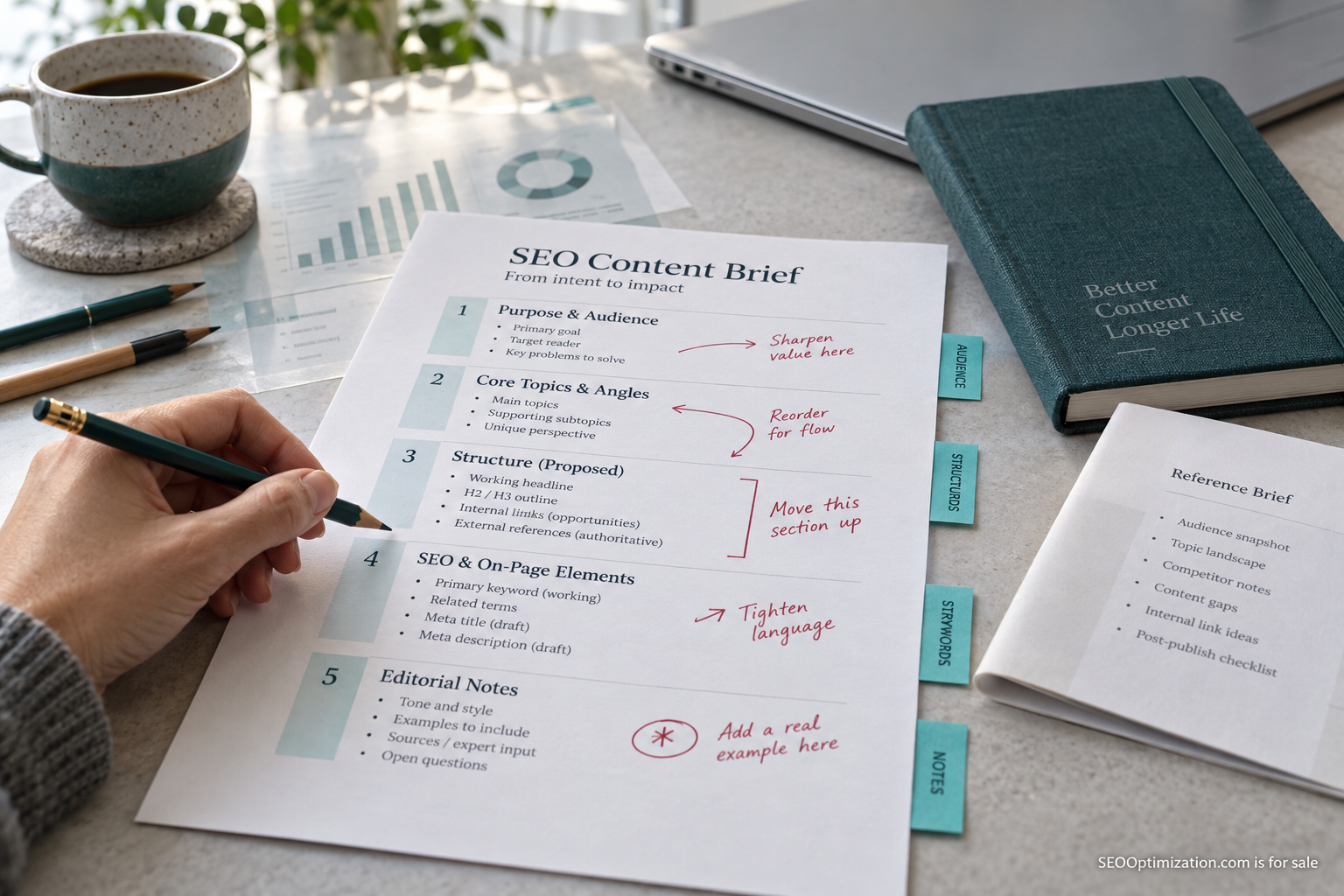
Most SEO briefs fail in the editor’s hands. They stuff keyword lists, invent volume, and leave writers without intent notes or source requirements. This guide shows brief sections, intent notes, and review gates that survive editors. Examples are templates, not claims about a live studio under SEOOptimization.com.
Reader job
You need briefs that help a writer produce a useful page and help an editor reject thin work without vague “make it more SEO” comments. The takeaway is a brief structure you can reuse, plus gates that keep honesty in the process.
Brief sections that earn their keep
Page job. One sentence on what the page should help the reader do or decide. If you cannot write that sentence, you are not ready for keywords.
Primary query and intent note. Name the main query family and whether the intent is informational, commercial investigation, transactional, or local. Add a short note on what a good result looks like. Intent notes beat synonym piles.
Audience and exclusions. Who it is for, and who it is not for. Exclusions stop writers from padding for the wrong reader.
Outline with jobs per section. Each H2 should have a job (define, compare, instruct, warn, decide). Outlines without jobs become heading theater.
Claims needing sources. List factual claims that must cite a primary source before editor approval. This is where medical, financial, and legal risk gets caught early on ordinary sites too: stop inventing statistics.
Internal links to prefer. Suggest destinations with a reason, not a dump of URLs.
SEO constraints. Title and meta direction, canonical notes, and template assumptions. Keep this short. If technical constraints dominate, the page may not be ready for a writer.
Done definition. What “ready for editor” means: section jobs met, sources attached, no invented volume claims, word count range if needed for layout, not as a quality proxy.
Intent notes without fairy tales
Keyword tools disagree. Treat volume as an estimate when you include it, and label it. Prefer evidence from Search Console queries you actually receive, sales call language, and competing page patterns. If you lack evidence, say “unknown; validate after publish” rather than inventing precision.
Write the intent note as a reader scenario. Example: “Reader comparing three mid-market CRM tools needs a clear feature comparison and pricing caveats, not a brand anthem.” That sentence guides the outline better than twenty loosely related phrases.
Review gates
Research gate. Before the brief leaves research, claims needing sources are listed and competing patterns are attached.
Writer gate. Writer confirms section jobs and flags brief gaps instead of guessing.
Editor gate. Editor checks sources, thin sections, and whether the page job was met. Rejection reasons are written, not vibes.
SEO QA gate. Titles, internal links, and template assumptions checked after edit, not as a substitute for editing.
Gates fail when anyone can bypass them under deadline pressure. Protect them in the project plan. A late brief is better than a published page that invents claims.
Template you can copy
Page job: … / Primary query: … / Intent note: … / Audience: … / Exclusions: … / Outline (H2 + job): … / Claims needing sources: … / Internal links: … / SEO constraints: … / Done definition: … / Volume estimates (optional, labeled): …
Keep the template boring. Fancy brief PDFs often hide missing intent notes behind design. Editors need clarity more than chrome.
Worked example
A B2B company needs a guide on evaluating email deliverability vendors. Page job: help a demand-gen lead shortlist vendors with clear evaluation criteria. Intent: commercial investigation. Audience: mid-market marketing ops; exclusions: consumer Gmail tips. Outline jobs include define deliverability factors, compare evaluation criteria, warn about vanity inbox-placement screenshots, and decide next steps for a pilot. Claims needing sources include any industry benchmark percentages. Internal links point to the company’s existing SMTP setup guide. SEO constraints note the article template and a canonical self-reference. Done definition requires two primary sources for any numeric claim and an editor pass on thin comparison sections.
The writer drafts. The editor rejects one section for missing sources. The SEO QA pass catches a missing internal link. The page ships without a fabricated “average open rate” chart. That is success for a brief system.
Common failure modes
Keyword stuffing lists with no intent note. Volume presented as fact. Outlines that mirror a competitor’s headings without a page job. Editors told to “add SEO” after the draft. Writers punished for asking clarifying questions. Fix the system, not the person who noticed the gap.
For further reading on search fundamentals that inform briefs, use creating helpful content guidance as a shared reference, not as a checklist to game.
Next step
Rewrite one brief with this template this week. Track editor rejection reasons for a month. If you are building a content SEO studio or SaaS brief product and evaluating SEOOptimization.com as the public address, inquire with vertical and workflow scope. This post remains a decision aid, not a studio claim.
Scaling briefs without diluting gates
As volume rises, teams try to automate outlines. Automation can draft scaffolding; it cannot own intent notes or source requirements. Keep humans on those fields. Measure brief cycle time and editor rejection reasons. If rejection reasons cluster on missing sources, fix research intake before hiring more writers.
Agencies and studios should show clients a redacted brief sample during sales. Clients who reject the gates are signaling a bad fit. Category branding will not repair a process that rewards thin drafts.
Writer enablement without keyword theater
Writers do better work when the brief answers practical questions before drafting starts. What is the reader trying to finish? What must be sourced? Which competing pages are useful patterns rather than templates to clone? Which internal pages deserve a link because they help the reader, not because a tool demanded a crawl path?
Train writers to return briefs that are incomplete instead of inventing answers. A returned brief with three clarifying questions is a process win. A draft built on guesswork becomes an editor tax. Measure how often briefs come back, and treat that as a research quality signal rather than a writer failure.
For teams mixing human writers with drafting tools, keep the same gates. Tools can propose outlines; humans still own intent notes, exclusions, and claims needing sources. If a tool inserts numeric claims, those claims enter the source list automatically. No exceptions for speed.
Agency clients sometimes ask for “SEO scores” on drafts. Prefer a qualitative editor checklist tied to the brief’s done definition. Scores from third-party tools can be an optional appendix, never the acceptance criteria for publishing.